
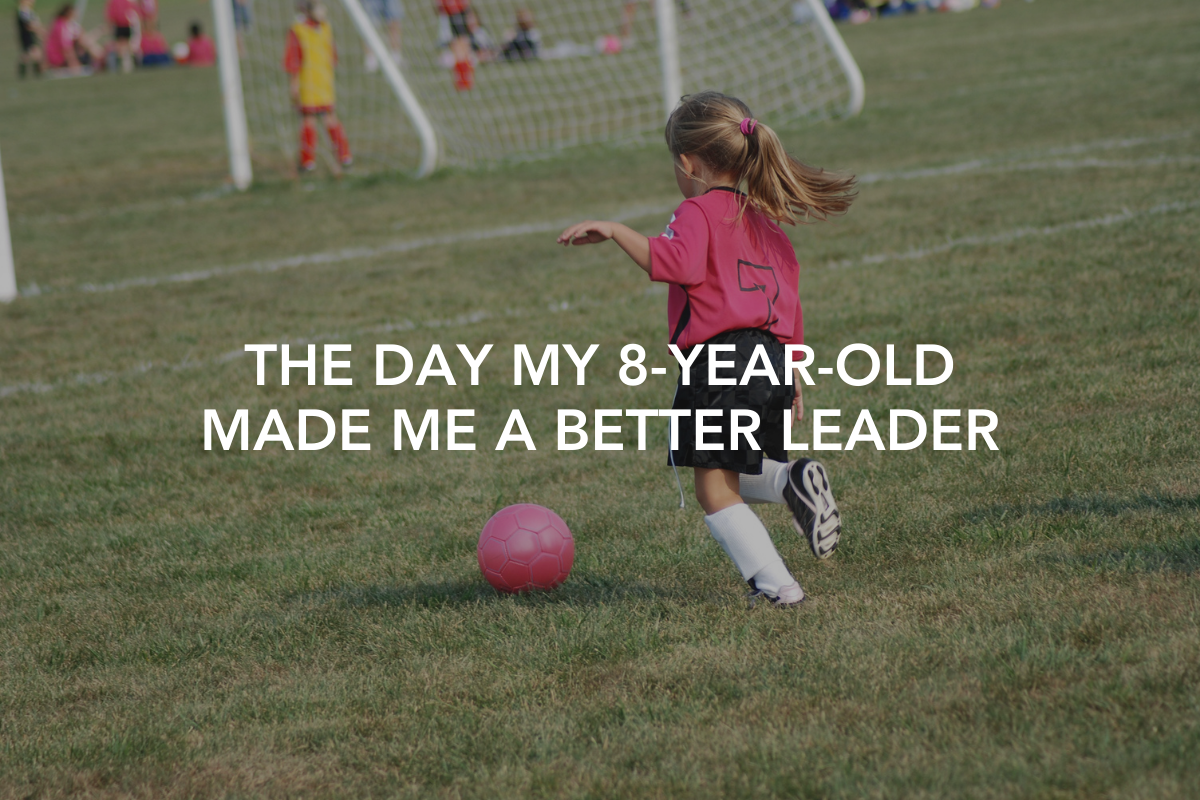
We are a passionate soccer family. For years, our house smelled like soccer balls and sweaty shin guards. Saturdays revolved around games, travel, and Wawa. Both of my kids played, and like many parents who love sports, I carried a second job as a youth soccer coach. It is still one of the best jobs of my career.
In the decade+ of my youth soccer coaching, one match stands out above the rest. It would become a defining moment of my life and leadership thanks to the smile of my 8-year-old daughter.
This match was highly competitive. It was hot. My daughter was playing with a cast on her wrist from a recent injury. And on that day, she did not play well. She knew it. I knew it. Everyone in the car knew it before the doors even closed. Then came the drive home.
For parents of athletes and for leaders, the “drive home” is sacred ground. It’s where confidence is either built or chipped away. Where leadership quietly forms in our lives or is pushed to a place that forces retreat. It’s where the scenario of “performance equals worth” is further established or removed. Where a sense of personal ownership happens, or a version of “dads” coaching voice takes center stage.
As she got into the car, I felt the “coach” rise in me. Should I…
Review the game?
Talk about the need for greater resilience in the heat?
Advise on how to battle through adversity?
Ask why she didn’t cut the ball to the outside or make quicker on-the-ball decisions?
I like to call this the post-game film session.
But in that moment, something hit me. Not intellectually, but instinctively: My daughter did not need a post-match evaluation. She needed safety. She needed to know that one game would not define her… or me. So instead of the breakdown I had mentally prepared, I simply said:
“I love watching you play.”
And that was it. No corrections. No coaching. No fixing. Just presence. The tension drained from the car. And we grabbed ice cream five minutes later. To this day, I can still see the spot of ice cream that sat on her smile long after she was done.
What I learned from her in that moment has been transformational in my leadership and career. I thought I was managing a soccer moment, but what I realized is that I was in the classroom of deep leadership growth, and I needed it. Here are five things I learned.
1. A high form of leadership is restraint.
When someone fails, their brain is already replaying the mistakes at full volume. In those moments, restraint may be the greatest gift a leader can offer. Feedback given too early often lands as pressure instead of instruction and can increase fear rather than growth. Correction delivered at the wrong time creates distance instead of trust. Leaders often assume immediacy equals effectiveness, but wise leaders know that timing often matters as much as truth.
2. Psychological safety precedes improvement.
Psychological safety is essential for building high-performing teams because it fuels innovation, trust, and growth. Before people can process what they did wrong, they need to know that a level of safety exists – that feedback is welcomed, healthy tension is normal, and care runs deep. When we change the nature and quality of the conversations on our teams, outcomes improve exponentially. Psychological safety is the core component that unlocks this. My daughter didn’t need coaching in that moment. She needed to know the car was a safe space.
Most environments operate like this:
Performance → Acceptance
But healthy development works the other way:
Trust → Growth → Performance
3. Don’t be content with making a point. Make a difference.
Most leadership mistakes aren’t about having the wrong principles. They come from applying the right principles at the wrong moment. Effective leadership requires recognizing the difference between teaching, processing, encouraging, and affirming. Great leaders discern the mode before they choose the message, understanding what the moment actually requires. And the people we lead grow best when honest feedback is delivered with wisdom and timing in the moments that matter most. We find that this is where a growing Emotional Intelligence is critical for growing leaders, and our team can help you grow in this area.
4. The relationship is the gateway to greater performance.
If I had coached my daughter in that moment, I might have helped her in her next game. By choosing connection instead, I strengthened the conversations that followed. She learned that her dad was for her (and I’m so glad I kept my mouth shut). And once that foundation was secure, coaching became welcome later, and performance improved because of it. Secure relationships reduce defensiveness, allowing honest evaluation and growth.
5. Invest in your Emotional Intelligence
Emotional intelligence is not measured by how well we read people; it is measured by how well we respond to what we read. Anyone can recognize frustration, fear, or disappointment. Emotionally intelligent leaders discern what the moment requires and adjust their response accordingly. At times it's coaching, at times encouragement, at times silence, and yes, at times challenge.
Great leaders don't just deliver the right message; they deliver it at the right time, in the right way, for the right reason to seek the best outcome. Because ultimately, emotional intelligence is the discipline of putting relationship before reaction and people before impulse so that growth can follow.
Contact us to learn more about how you can increase your leadership EQ.

Billy Dunn is Vice President & Senior Consultant at The Center Consulting Group and has over 20 years of church and nonprofit leadership experience. He serves as the Character Coach for the Lehigh University Men’s Basketball team and the Director of Ministry Leadership for Word FM. Billy has assisted with the launch of a number of nonprofit organizations and has worked with organizations and ministries across the world. Billy has an M.S. in Organizational Leadership and brings experience in the areas of leading change, leadership coaching, resource development, church growth planning, and strategic thinking and planning.



![The Power of Encouragement [VIDEO]](https://images.squarespace-cdn.com/content/v1/571fc0ea1d07c0fd6d72c167/1789414441004-N7DEHJI02NM0YVIT8N7P/encouragement+blog.png)








![Effective Execution: 4 Steps to Follow Through on Your Strategy [VIDEO]](https://images.squarespace-cdn.com/content/v1/571fc0ea1d07c0fd6d72c167/1781035467211-90HEYTKBR01ZC8FUW8ZM/executive+blog.png)



![Unlocking Business Value: How to Elevate Your Company’s Worth [VIDEO]](https://images.squarespace-cdn.com/content/v1/571fc0ea1d07c0fd6d72c167/1778005993844-SA0MZVFB9I081V7ZRFQT/worth+blog.png)


![Leadership: Effective Leaders Drive Stick [VIDEO]](https://images.squarespace-cdn.com/content/v1/571fc0ea1d07c0fd6d72c167/1775573759312-L2X9PK1JUYIFFY2M67YX/drive+stick+blog.png)


![Integrating Faith in Leadership [VIDEO]](https://images.squarespace-cdn.com/content/v1/571fc0ea1d07c0fd6d72c167/1773077890675-S71UXOHTLCJDC99K223B/Panel+Discussion+Thumbnail+-+faith+in+leadership.png)



We are hearing it from organizations of every size: leaders are struggling to step up under pressure. Here are five ways to build courage and resilience into your leadership and your team.