
I am a terrible cook. Trust me, I am not exaggerating. I once used salt instead of sugar while making brownies. Needless to say, they were inedible. But the interesting thing is, even if I had followed the recipe perfectly, they still wouldn’t have been truly great. The best chefs don't just read the instructions; they add something more. They might substitute an ingredient, add a unique spice, or bring a new perspective to a classic dish. They add a little bit of themselves.
The same is true for a great speech. Simply using AI to generate a speech will not make it a success. So how do we ensure we are adding that "little bit of ourselves" when so many speakers are relying on outside help?
Having someone else write your material isn’t new. For decades, many have turned to ghostwriters or professional speechwriters. But with the rise of artificial intelligence, now everyone has access to a tool that can both help and harm. The data shows just how quickly this is happening: a recent Gallup study found that AI use at work has nearly doubled in just two years, with 40% of U.S. employees now using it at least a few times a year or more.
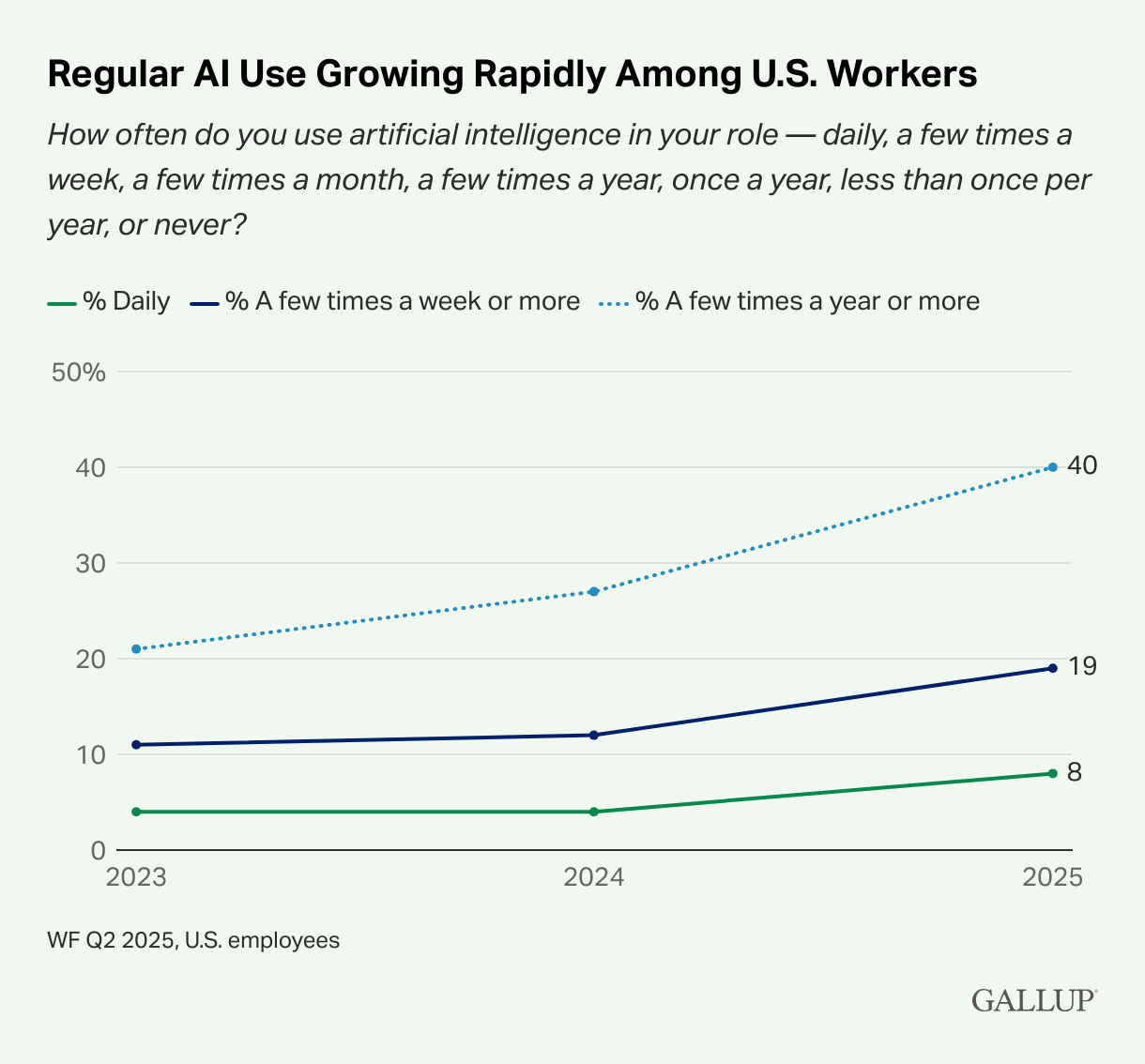
This isn't just a handful of people; this is the new normal.
1. An Ethical Base for Using AI
So, before we dive into how to use it, we must first lay an ethical foundation. We have all seen the videos of AI-generated deepfakes and heard the news of a professor being fired for using AI without proper disclosure. If we are not careful, we risk having AI turn public speaking into a sterile, impersonal experience. And a recent study found that more than half of Americans have little or no confidence in content created with AI, and over 90% of engaged consumers want clear disclosures.
We must use AI to enhance our humanity, not to hide it. Unlike a ghostwriter, who brings their own perspective and style, AI is simply a mirror. It can only reflect what we put into it. We need to be aware of the biases that can be incorporated and ensure our use of this technology promotes, rather than erodes, the diversity of human expression.
2. Essential Ingredients Needed in a Speech
Now, let's look at how we can use AI responsibly to add the essential ingredients to our speech.
Experience: First, we need to bring our experience. AI can't live your life. It can’t feel your struggles or celebrate your triumphs. But it can be an invaluable partner in helping you share those experiences. Think of it as a sparring partner for your ideas. You can tell AI a story from your life or about a key moment from your career, and it can help you brainstorm different ways to tell that story, find the most impactful details, and shape it into a narrative that will resonate with your audience. It helps ensure that when you stand on that stage, you are not reciting a script – you are sharing a part of yourself.
Emotion & Enthusiasm: This leads us directly to the next part of our recipe, emotion and enthusiasm. I always tell my public speaking students that delivery is of utmost importance. You can have the best content in the world, but if the speech is delivered poorly (let’s say you speak too quietly and we are only hearing every other word), it doesn’t matter how phenomenal the content is because the speech is going to be a disaster. During the delivery, the human connection is everything.
Tools like Yoodli (an AI-powered communications tool) can act as a virtual coach, analyzing your vocal tone and pacing in a safe and private space. This isn't about AI telling you how to feel, but about helping you make sure your delivery matches your intended emotion. It’s a tool for refining, not replacing, your passion.
3. Being Extemporaneous
Finally, we come to the crucial element of being extemporaneous. This isn't about perfectly memorizing a speech, which makes it sound robotic. The goal is to know your material so well that you can deliver it naturally, even if you stray from your notes. An AI coach can help with this, too. By practicing with it, you get immediate feedback on things like your reliance on filler words like "um" or "like" or how to find stronger transitions. This practice allows you to internalize your message so deeply that when you are on stage, you can focus on connecting with your audience, not on remembering the next line.
So, let's use AI as part of our recipe for a powerful speech, a recipe that helps us find our voice, polish our delivery, and ensure our stories are heard. But don’t forget that the fire – the experience, the emotion, the enthusiasm – that’s what makes a speech truly great. And that is all on us.
If we can help you with enhancing the public speaking or communications skills for you or your employees, please contact us at The Center Consulting Group.

With over 25 years teaching at both public and private universities, Tiffany Ironside, M.S. has a passion for helping others communicate more effectively. She has dedicated the majority of her professional career to higher education and was both an in-person and online instructor for a variety of communication related courses, including oral communications, public relations, family communication, and acting. Tiffany is a graduate of Messiah University holding a B.A. in Communication with an emphasis on Speech and Film and an M.S. from Shippensburg University in Communication Studies.
![The Power of Encouragement [VIDEO]](https://images.squarespace-cdn.com/content/v1/571fc0ea1d07c0fd6d72c167/1789414441004-N7DEHJI02NM0YVIT8N7P/encouragement+blog.png)
![Effective Execution: 4 Steps to Follow Through on Your Strategy [VIDEO]](https://images.squarespace-cdn.com/content/v1/571fc0ea1d07c0fd6d72c167/1781035467211-90HEYTKBR01ZC8FUW8ZM/executive+blog.png)
![Unlocking Business Value: How to Elevate Your Company’s Worth [VIDEO]](https://images.squarespace-cdn.com/content/v1/571fc0ea1d07c0fd6d72c167/1778005993844-SA0MZVFB9I081V7ZRFQT/worth+blog.png)
![Leadership: Effective Leaders Drive Stick [VIDEO]](https://images.squarespace-cdn.com/content/v1/571fc0ea1d07c0fd6d72c167/1775573759312-L2X9PK1JUYIFFY2M67YX/drive+stick+blog.png)
![Developing a Successful Sales and Marketing Strategy [VIDEO]](https://images.squarespace-cdn.com/content/v1/571fc0ea1d07c0fd6d72c167/1770391559147-9Z6Q4BC1EY0R8BUHCATM/sales+blog.png)
![Gratitude: A Silver Bullet for Strengthening Morale [VIDEO]](https://images.squarespace-cdn.com/content/v1/571fc0ea1d07c0fd6d72c167/1768246672364-PQNI8VHO5EEPZ3IRMY7F/gratitude+blog.png)
![Public Speaking: Using AI Ethically & Effectively to Create a Powerful Speech [VIDEO]](https://images.squarespace-cdn.com/content/v1/571fc0ea1d07c0fd6d72c167/1763735597032-XMIKMQ1D63PRC1QJ6FVV/ai+speech+blog.png)
![Preparing for the (Expectedly) Unexpected [VIDEO]](https://images.squarespace-cdn.com/content/v1/571fc0ea1d07c0fd6d72c167/e4193bcf-29f7-46c2-be12-9116791d40cf/unexpected+blog.png)
![Fundraising: How to Raise Funds for Your Nonprofit [VIDEO]](https://images.squarespace-cdn.com/content/v1/571fc0ea1d07c0fd6d72c167/1757619882819-6OARWR0QU11M7LA0ABYL/fundraising+blog.png)
![Culture: 5 Traits That Set Healthy Churches & Their Leaders Apart [VIDEO]](https://images.squarespace-cdn.com/content/v1/571fc0ea1d07c0fd6d72c167/1755633039402-KVJFNJWG0RKBCMLS5FNB/healthy+blog.png)
![Vision: 3 Must-Have Traits of Every Successful Visionary Leader [VIDEO]](https://images.squarespace-cdn.com/content/v1/571fc0ea1d07c0fd6d72c167/1749484247758-ITEGD2LZZ716112KLHXZ/visionary+blog.png)
![Advisory Boards: Should Your Business Have an Advisory Board? [VIDEO]](https://images.squarespace-cdn.com/content/v1/571fc0ea1d07c0fd6d72c167/1747149791510-HU20SY0O8LRPEHGMC6HD/advisory+blog.png)
![Leadership: How to Be a World Class Boss [VIDEO]](https://images.squarespace-cdn.com/content/v1/571fc0ea1d07c0fd6d72c167/1744640489138-X5LUNZT3JTRQYSSZXV1C/boss+thumbnail.png)
![Conflict: The Importance of Having Tough Conversations [VIDEO]](https://images.squarespace-cdn.com/content/v1/571fc0ea1d07c0fd6d72c167/1741365599296-KTWEJ5PTNH1BX2GJ9REJ/Conversations+blog.png)
![Exit Planning: The Challenge of Business Exit Planning & Why It Matters to You [VIDEO]](https://images.squarespace-cdn.com/content/v1/571fc0ea1d07c0fd6d72c167/1738339040891-VIW87N2NCZUCKLYNOHB6/exit+blog.png)

![Teams: Is Your Team Dysfunctional? [VIDEO]](https://images.squarespace-cdn.com/content/v1/571fc0ea1d07c0fd6d72c167/1733243870005-NOI69Z74DLNVLIB8MRRJ/dysfunctional+blog.png)
![How to Recruit and Inspire Volunteers [VIDEO]](https://images.squarespace-cdn.com/content/v1/571fc0ea1d07c0fd6d72c167/1728421227208-6JAUFVXEJW5KK6YE58JR/volunteers+blog.png)
![Trust: 4 Steps to Rebuild Damaged Trust [VIDEO]](https://images.squarespace-cdn.com/content/v1/571fc0ea1d07c0fd6d72c167/1725969594417-7AN9PJO2X8TTR77ACDFP/trust+blog.png)
![Blind Spots: How to Identify & Avoid Blind Spots in Your Organization [VIDEO]](https://images.squarespace-cdn.com/content/v1/571fc0ea1d07c0fd6d72c167/1722610352594-FAXECLPC61QYJH2I5YT8/blind+spot+blog.png)
![Family Business: Will the Family Business Destroy Our Family? [VIDEO]](https://images.squarespace-cdn.com/content/v1/571fc0ea1d07c0fd6d72c167/1718027719043-MU9AYPTQ7GM4XWT9EGD1/destroy+blog.png)
![Teams: How to Breathe New Life into a Broken Team [VIDEO]](https://images.squarespace-cdn.com/content/v1/571fc0ea1d07c0fd6d72c167/1714749389916-G2CWVK8OM1JJSD9058CL/breathe+blog.png)
![Planning: The Power of Planning [VIDEO]](https://images.squarespace-cdn.com/content/v1/571fc0ea1d07c0fd6d72c167/1712597764732-WHRZPRLZ6V78CBGKBPZA/PLanning+blog.png)
![Leveling Up Your Leadership: Becoming an Effective Senior Leader [VIDEO]](https://images.squarespace-cdn.com/content/v1/571fc0ea1d07c0fd6d72c167/1710266273593-QN3HEBJ5FII4GKQFH91Q/leveling+up+blog.png)
![Recruiting & Retaining “Mature” Team Members [VIDEO]](https://images.squarespace-cdn.com/content/v1/571fc0ea1d07c0fd6d72c167/1707849950823-Y5WJLYXM6ZPU55TKG27Y/recruitment+blog.png)

![Gaslighting: How to Identify It & Take Back Control [VIDEO]](https://images.squarespace-cdn.com/content/v1/571fc0ea1d07c0fd6d72c167/1699381799669-Y6XNYG2X3ZD1US80XAFY/Gaslighting+blog.png)
![Decision-Making: Why Smart Leaders Do Dumb Things [VIDEO]](https://images.squarespace-cdn.com/content/v1/571fc0ea1d07c0fd6d72c167/1696947285846-ZIA5M26B5AF9SRFGWFPV/Dumb+Things+blog.png)
We are hearing it from organizations of every size: leaders are struggling to step up under pressure. Here are five ways to build courage and resilience into your leadership and your team.