
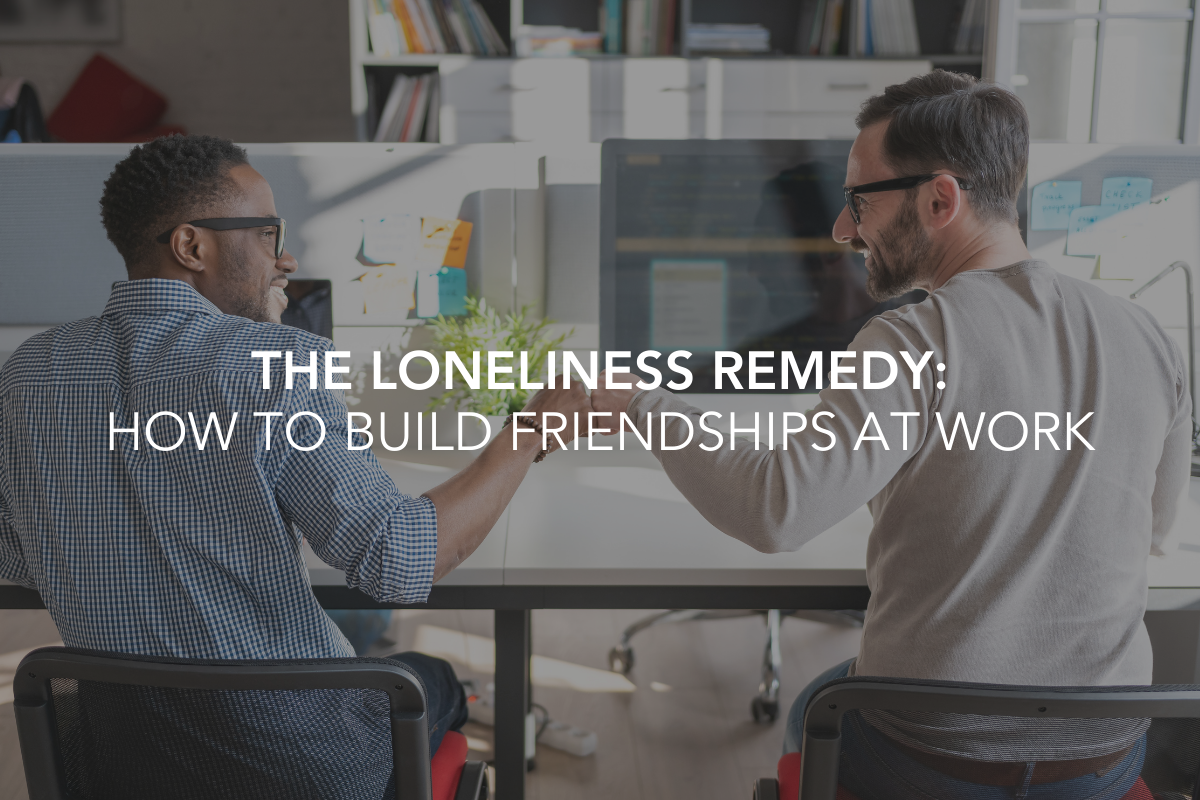
Are people really experiencing increased feelings of loneliness? There has been a lot of debate regarding whether people are as lonely as some of the surveys say. For example, the American Perspectives Survey discovered that, over the past 35 years, the percentage of U.S. adults who report having no close friends has quadrupled. Another survey found that 46 million people have just one person or no one to help them if they need it. Perhaps the state of loneliness is real, or maybe it is just unrealistic expectations. But it would be fair to say that people have fewer close friends than they used to. And this is concerning since relational connection is essential to emotional and physical health as well as to the health of our society.
For much of our recent history, the three most effective places to form supportive friendships are in your local community or neighborhood, your church, and the place you work. But fewer people are heavily involved in a church on a regular basis. In addition, a growing number of people do not know their neighbors in any personal way, and people move often enough that such relationships have a short lifespan. And then there is work. The place that many people spend 20-50 hours or more every week. Landscape company, ski shop, church, university, consulting practice – these are just a few of the many jobs I have had in my life. And in each one, I had the opportunity to work with some great people, and several became lifelong friends.
While remote work has changed some aspects of what interaction with others looks like in the workplace, the vast majority of workers (73%) still go to a physical workplace for at least part of their work hours. Which means work is still one of the top places to build meaningful relationships. And when this is done well, employees are healthier, happier, stay longer, and perform better than those who feel socially lost. So, when I hear someone say, “I keep my work life and relational life separate,” or “I don’t go to work to make friends,” I say, “That is not wise.”
If an employee, manager, or owner wants to create a workplace that enhances relational connections, it is as simple as regularly doing these six things, and they don’t even cost a nickel (now that pennies are extinct).
1. Respect one another.
Oxford defines respect as a feeling of deep admiration for someone or something elicited by their abilities, qualities, or achievements. I recently read about one of the top ten comedians of all time and how, at times in his career, he showed little respect for some of his coworkers. Rather than do simple things that show respect, like talking honorably and accepting feedback, he would do the opposite, which resulted in very little friendship at work.
2. Encourage one another.
One of the common traits I see in teams or organizations that have great friendships is the natural tendency to encourage one another. Not in a forced or artificial way, but in a way that seems so innate and natural to them. They affirm accomplishments, and they highlight unique strengths and talents. This creates a great environment for healthy friendships at work. Some people are natural encouragers. Others, like me, need to constantly work at it and seek to be more intentional about it.
3. Be social with one another.
Years ago, I invited a colleague to my daughter’s graduation party. I felt it was a normal thing to do since we had a close working relationship. But it was interesting and sad that the individual not only didn’t attend, but they also didn’t RSVP. Healthy relationships at work (or any other place) are built upon being social with one another.
4. Forgive one another.
If you want to watch friendships dissolve like an ice cube under water, just withhold forgiveness. Look, we are all very human and make mistakes that hurt someone’s feelings, whether intentional or not. The book of the Bible called Proverbs says that overlooking an offense of someone serves as a way to strengthen a friendship. Sometimes, the best approach to a good friendship is to let it go and move on rather than hold a grudge and allow a wall to form.
5. Help one another.
When I was a kid, my Italian mother would bring Baked Ziti to a neighbor when they lost a loved one. Baked Ziti did not take away the loss, but it communicated love and provided practical help for the family and their guests. When a team member needs input or ideas regarding a client or a project, they stop into a few offices or send a few emails, and every Center team member is quick to offer help. Isolated people do not help one another. But friends – they always help each other.
6. Challenge one another.
The highest quality friendships do not always feel like a fluffy blanket. Friends care about one another enough to challenge and speak the truth to each other. There can be an intensity to friendships. Someone told me about a recent encounter where they had to say some hard things to a friend. They did this because they care about this friend. People who do not genuinely care about another person will seldom go through the hassle of a potential conflict. But friendships, including those in the workplace, include appropriately challenging one another to do better and be better.
If you want to build a culture where friendships form and people thrive, our team would love to help. Contact us to learn how we can help you design a culture that strengthens both performance and connection.

Jay Desko is the President & CEO of The Center Consulting Group and brings experience in the areas of organizational assessment, leadership coaching, decision-making, and strategic questioning. Jay’s degrees include an M.Ed. in Instructional Systems Design from Pennsylvania State University and a Ph.D. in Organizational Behavior and Leadership from The Union Institute.



We are hearing it from organizations of every size: leaders are struggling to step up under pressure. Here are five ways to build courage and resilience into your leadership and your team.