
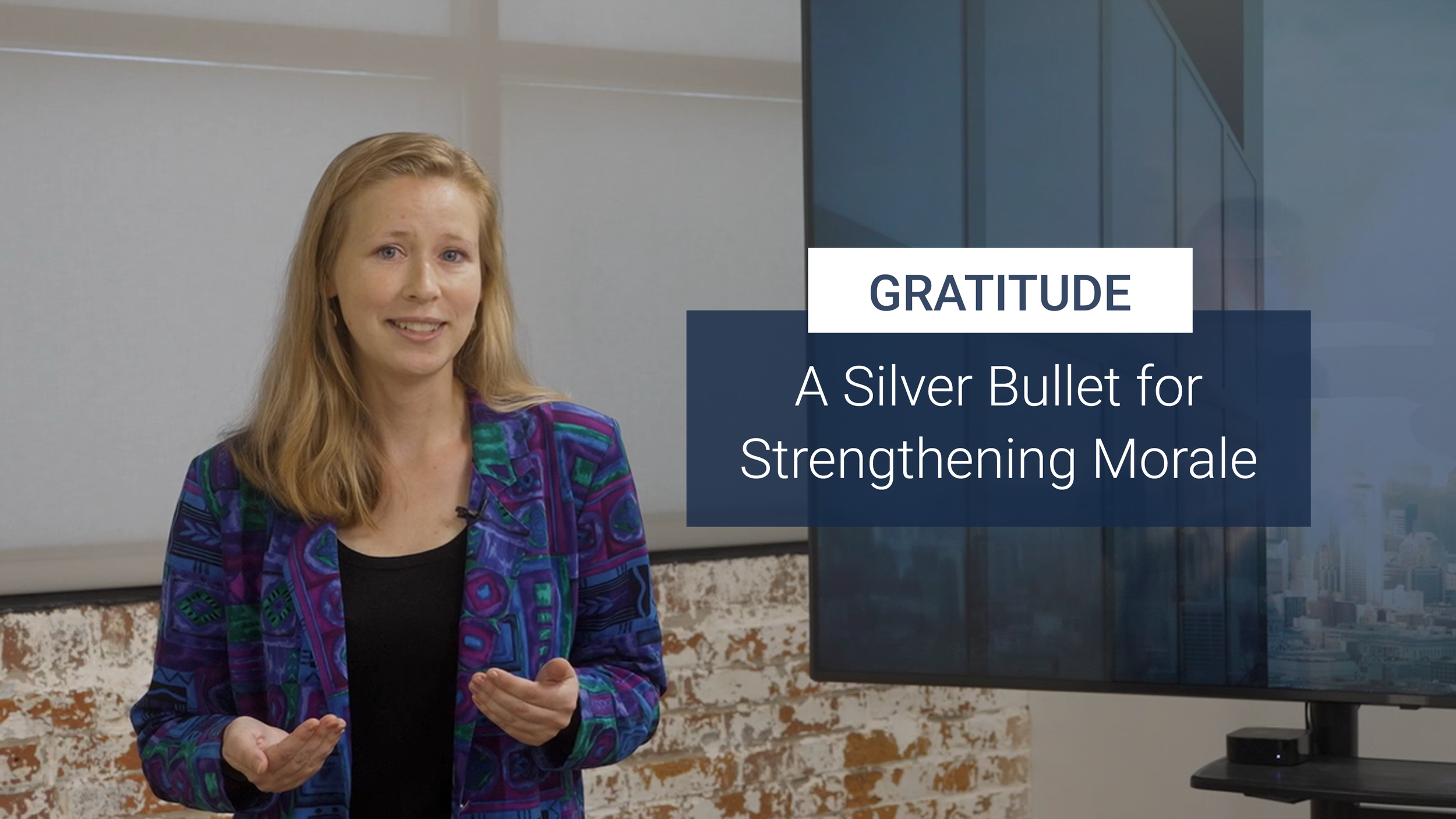
Gratitude: A Silver Bullet for Strengthening Morale [VIDEO]
One trillion dollars. U.S. businesses, in the aggregate, are losing nearly one trillion dollars annually due to employee turnover, according to Work Institute’s 2025 Retention Report. Surveys indicate that meaningful recognition of employees improves job satisfaction and motivation. This can be as simple as a personal thank you. 71% of full-time employees in the U.S. are less likely to are less likely to leave their organization if they are recognized more.
In a society where we are constantly looking for quick fixes to complex issues, employee turnover is a complex issue, and gratitude is one silver bullet that can strengthen morale in the workplace. Gratitude is the ultimate performance-enhancing substance; yet, it is often overlooked and underutilized in the workplace.
Today, we are going to discuss:
The benefits of practicing gratitude
The two parts of gratitude (internal and external gratitude)
Three tiny habits to cultivate gratitude in your workplace and beyond
The Benefits of Practicing Gratitude
Gratitude is an appreciation for what is valuable and meaningful to oneself. Practicing gratitude habits can:
Reduce stress
Improve job performance and sleep quality
Increase the quality of romantic relationships
Biologically, we release dopamine and serotonin in our brains when we express and receive gratitude. These neurotransmitters affect our motivation, happiness, contentment, and sleep cycles. Deficiencies can lead to depression, anxiety, and lack of motivation. By practicing genuine gratitude, your body naturally releases these important neurotransmitters. This is an incredible benefit.
The Two Parts of Gratitude
Now, let’s discuss the two parts of gratitude, internal and external gratitude. Internal gratitude helps us express gratitude externally. So, we will first look at internal gratitude.
Internal Gratitude
Internal gratitude is:
Appreciating your present (what you have while you have it)
Giving thanks for who you are and what you have to offer
When life is good, it can feel easy to be grateful, but internal gratitude is most tested and helpful in the tough, dark moments of life.
For me, it was tested during law school when I had to take a year-long medical leave due to tick-borne diseases. During this time, I had a myriad of symptoms, was flat on my back, and had to move home so my parents could take care of me. I went from being independent and self-reliant to completely dependent due to my illness. During that year, I began practicing gratitude daily; it changed my mindset and is something I still do to this day.
Practicing gratitude helped me focus on the good in who I was, what I still had, and my present circumstances. It could be incredibly difficult some days, and sometimes my blessings were as small as a warm cup of tea or having the strength to go for a walk that day. But with persistent practice, it became a habit and totally changed my mindset so I was able to focus on the positive.
When we are able to internally express gratitude, it helps in business situations as well. In business, we are constantly looking to the future and to solve the next problem. But just like an illness attacks our bodies, our minds can develop into internal bullies that are never satisfied in the present. Practicing gratitude shifts our internal perspective to see the positive in situations, and this breeds contentment, not complacency.
External Gratitude
Looking for the positive helps us express to the people we work with that their presence and work have value in the workplace and beyond. This is an excellent way to combat employee turnover.
External gratitude reassures people we work with that their effort is seen and valued by the organization. When this type of gratitude is personal and meaningful, it signals to that person that they belong; they are a part of the organization. It creates genuine connection and strengthens the relationship. The more you sincerely thank others, the more you reinforce this.
Three Tiny Gratitude Habits
Practicing gratitude is important, but how do we do this? The following are three ways you can start practicing gratitude today.
1. Three blessings
Take 1-2 minutes out of your day and write down three things you are thankful for from your day. Some days this can feel impossible, but like working out a muscle, the more you practice, the easier it becomes. Three blessings will help shift your internal perspective to see the positive in yourself and your circumstances.
2. Three thank you notes
Think about your career and ask yourself who has helped you succeed. List the first 25 people that come to mind. How many have you thanked? Choose three people from your list and write them each a personal thank you note. Thank you notes are encouraging and sometimes can come at the exact moment we need them.
3. Daily thank yous
Look for someone who is doing a good job or has done something special and personally thank them.
Over the next month, I challenge you to choose two habits to practice, and then, consider how your perspective has changed after a month. I would love to hear your experiences with this challenge and your thoughts on gratitude in the comments. I hope gratitude can change your life just like it changed mine.
If we can help you increase your leadership effectiveness through a customized coaching plan, please contact us at The Center Consulting Group.

Meghan Hunter Harrison, Esq., is a Senior Consultant at The Center Consulting Group and brings experience in the fields of law, construction, nonprofit work, and event planning. Previously, she worked as a construction litigation associate at Troutman Pepper Locke with pro bono work in the spheres of election and immigration law. Her expansive community service background has allowed her to serve as an event coordinator for a nonprofit and a public speaker for health advocacy. She has also served on nonprofit boards. Meghan received the President's Volunteer Service Award from President Obama, among other accolades. She holds a J.D. from William & Mary Law School and a B.S. in Biochemistry from the University of Tulsa.
![Effective Execution: 4 Steps to Follow Through on Your Strategy [VIDEO]](https://images.squarespace-cdn.com/content/v1/571fc0ea1d07c0fd6d72c167/1781035467211-90HEYTKBR01ZC8FUW8ZM/executive+blog.png)
![Unlocking Business Value: How to Elevate Your Company’s Worth [VIDEO]](https://images.squarespace-cdn.com/content/v1/571fc0ea1d07c0fd6d72c167/1778005993844-SA0MZVFB9I081V7ZRFQT/worth+blog.png)
![Leadership: Effective Leaders Drive Stick [VIDEO]](https://images.squarespace-cdn.com/content/v1/571fc0ea1d07c0fd6d72c167/1775573759312-L2X9PK1JUYIFFY2M67YX/drive+stick+blog.png)
![Developing a Successful Sales and Marketing Strategy [VIDEO]](https://images.squarespace-cdn.com/content/v1/571fc0ea1d07c0fd6d72c167/1770391559147-9Z6Q4BC1EY0R8BUHCATM/sales+blog.png)
![Gratitude: A Silver Bullet for Strengthening Morale [VIDEO]](https://images.squarespace-cdn.com/content/v1/571fc0ea1d07c0fd6d72c167/1768246672364-PQNI8VHO5EEPZ3IRMY7F/gratitude+blog.png)
![Public Speaking: Using AI Ethically & Effectively to Create a Powerful Speech [VIDEO]](https://images.squarespace-cdn.com/content/v1/571fc0ea1d07c0fd6d72c167/1763735597032-XMIKMQ1D63PRC1QJ6FVV/ai+speech+blog.png)
![Preparing for the (Expectedly) Unexpected [VIDEO]](https://images.squarespace-cdn.com/content/v1/571fc0ea1d07c0fd6d72c167/e4193bcf-29f7-46c2-be12-9116791d40cf/unexpected+blog.png)
![Fundraising: How to Raise Funds for Your Nonprofit [VIDEO]](https://images.squarespace-cdn.com/content/v1/571fc0ea1d07c0fd6d72c167/1757619882819-6OARWR0QU11M7LA0ABYL/fundraising+blog.png)
![Culture: 5 Traits That Set Healthy Churches & Their Leaders Apart [VIDEO]](https://images.squarespace-cdn.com/content/v1/571fc0ea1d07c0fd6d72c167/1755633039402-KVJFNJWG0RKBCMLS5FNB/healthy+blog.png)
![Vision: 3 Must-Have Traits of Every Successful Visionary Leader [VIDEO]](https://images.squarespace-cdn.com/content/v1/571fc0ea1d07c0fd6d72c167/1749484247758-ITEGD2LZZ716112KLHXZ/visionary+blog.png)
![Advisory Boards: Should Your Business Have an Advisory Board? [VIDEO]](https://images.squarespace-cdn.com/content/v1/571fc0ea1d07c0fd6d72c167/1747149791510-HU20SY0O8LRPEHGMC6HD/advisory+blog.png)
![Leadership: How to Be a World Class Boss [VIDEO]](https://images.squarespace-cdn.com/content/v1/571fc0ea1d07c0fd6d72c167/1744640489138-X5LUNZT3JTRQYSSZXV1C/boss+thumbnail.png)
![Conflict: The Importance of Having Tough Conversations [VIDEO]](https://images.squarespace-cdn.com/content/v1/571fc0ea1d07c0fd6d72c167/1741365599296-KTWEJ5PTNH1BX2GJ9REJ/Conversations+blog.png)
![Exit Planning: The Challenge of Business Exit Planning & Why It Matters to You [VIDEO]](https://images.squarespace-cdn.com/content/v1/571fc0ea1d07c0fd6d72c167/1738339040891-VIW87N2NCZUCKLYNOHB6/exit+blog.png)

![Teams: Is Your Team Dysfunctional? [VIDEO]](https://images.squarespace-cdn.com/content/v1/571fc0ea1d07c0fd6d72c167/1733243870005-NOI69Z74DLNVLIB8MRRJ/dysfunctional+blog.png)
![How to Recruit and Inspire Volunteers [VIDEO]](https://images.squarespace-cdn.com/content/v1/571fc0ea1d07c0fd6d72c167/1728421227208-6JAUFVXEJW5KK6YE58JR/volunteers+blog.png)
![Trust: 4 Steps to Rebuild Damaged Trust [VIDEO]](https://images.squarespace-cdn.com/content/v1/571fc0ea1d07c0fd6d72c167/1725969594417-7AN9PJO2X8TTR77ACDFP/trust+blog.png)
![Blind Spots: How to Identify & Avoid Blind Spots in Your Organization [VIDEO]](https://images.squarespace-cdn.com/content/v1/571fc0ea1d07c0fd6d72c167/1722610352594-FAXECLPC61QYJH2I5YT8/blind+spot+blog.png)
![Family Business: Will the Family Business Destroy Our Family? [VIDEO]](https://images.squarespace-cdn.com/content/v1/571fc0ea1d07c0fd6d72c167/1718027719043-MU9AYPTQ7GM4XWT9EGD1/destroy+blog.png)
![Teams: How to Breathe New Life into a Broken Team [VIDEO]](https://images.squarespace-cdn.com/content/v1/571fc0ea1d07c0fd6d72c167/1714749389916-G2CWVK8OM1JJSD9058CL/breathe+blog.png)
![Planning: The Power of Planning [VIDEO]](https://images.squarespace-cdn.com/content/v1/571fc0ea1d07c0fd6d72c167/1712597764732-WHRZPRLZ6V78CBGKBPZA/PLanning+blog.png)
![Leveling Up Your Leadership: Becoming an Effective Senior Leader [VIDEO]](https://images.squarespace-cdn.com/content/v1/571fc0ea1d07c0fd6d72c167/1710266273593-QN3HEBJ5FII4GKQFH91Q/leveling+up+blog.png)
![Recruiting & Retaining “Mature” Team Members [VIDEO]](https://images.squarespace-cdn.com/content/v1/571fc0ea1d07c0fd6d72c167/1707849950823-Y5WJLYXM6ZPU55TKG27Y/recruitment+blog.png)

![Gaslighting: How to Identify It & Take Back Control [VIDEO]](https://images.squarespace-cdn.com/content/v1/571fc0ea1d07c0fd6d72c167/1699381799669-Y6XNYG2X3ZD1US80XAFY/Gaslighting+blog.png)
![Decision-Making: Why Smart Leaders Do Dumb Things [VIDEO]](https://images.squarespace-cdn.com/content/v1/571fc0ea1d07c0fd6d72c167/1696947285846-ZIA5M26B5AF9SRFGWFPV/Dumb+Things+blog.png)

Withhold encouragement from your team, and you will lose creativity, initiative, and commitment. Give it generously, and you will multiply their performance. Here’s how.