
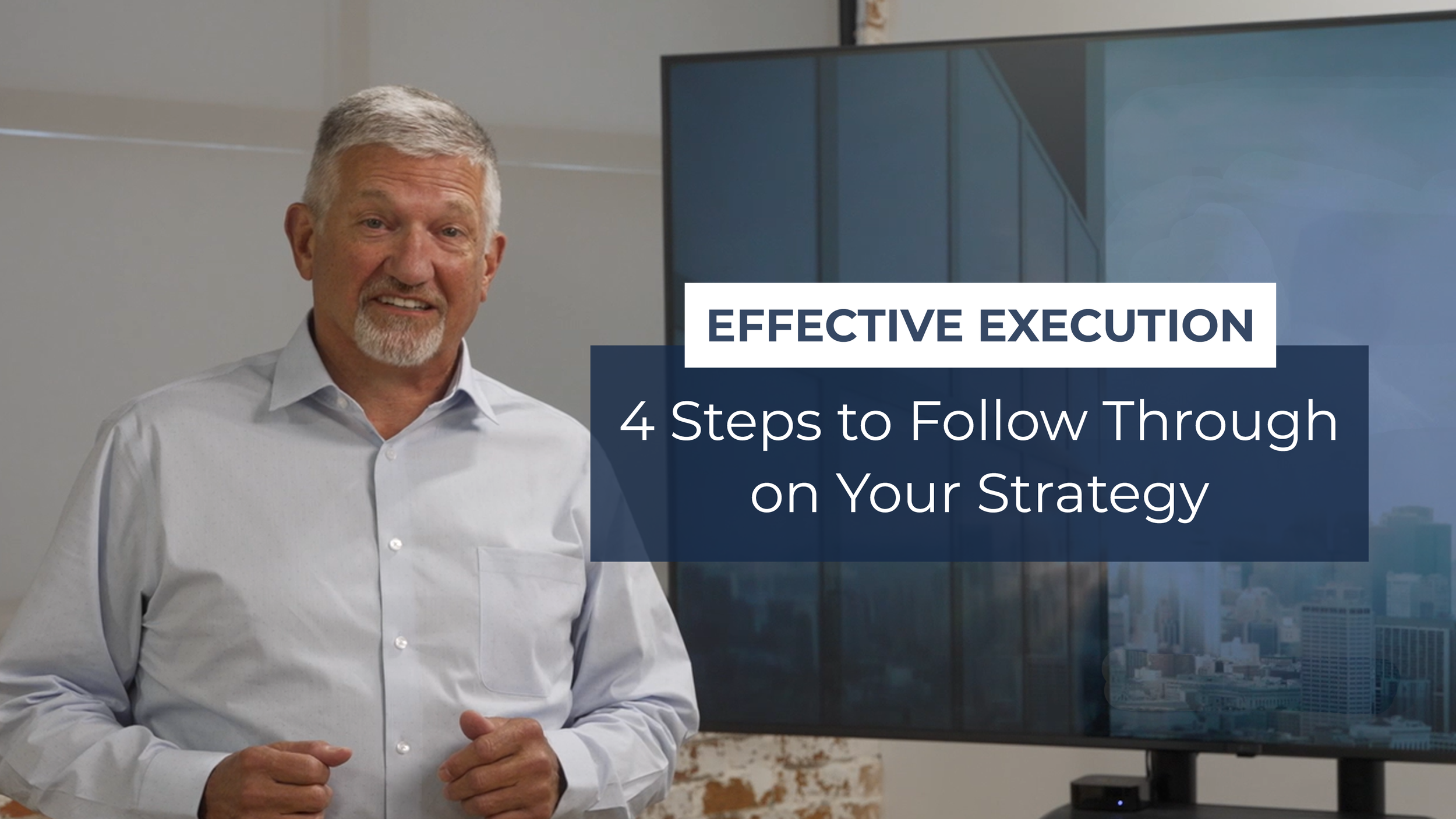
Effective Execution: 4 Steps to Follow Through on Your Strategy [VIDEO]
There’s a famous quote by full-time boxer and part-time philosopher Mike Tyson that says, “Everyone has a plan until they get punched in the mouth.” If you are leading an organization, it often feels like you are in the 18th round of a prize fight, doesn’t it? You are dodging blows, trying to get through the end of the round, but you wonder if there is really any plan left at all. Many organizations we work with have a strategic plan. We will ask to see it, and they will say, “Oh it’s on the wall over there,” or, “Let’s look in the file drawer and see if we can find it.” A lot of us have plans, but life has a way of taking over, and those plans do not find their way to execution very well.
I want share four ideas that will help you effectively execute your plan and do a better job pushing it forward. But, first, I will start with reasons why we often can’t execute our plan well.
Why We Fail to Execute Well
1. We haven’t been clear.
Maybe we don’t have a clear path forward, or we have a lot of ideas, but we haven’t coalesced the plan that will really come together.
2. It was a top-down initiative with NO team ownership.
There’s often a plan that’s been put together by a few leaders in a small room working together, but that plan has not been spread through the organization. And those implementing the plan and executing the steps don’t know how they fit into the bigger picture.
3. We get distracted by new opportunities.
I’ve worked with an organization where the leader did a wonderful thing. He was offered a terrific opportunity with funding, yet he chose to say no because it was not part of their strategic plan. That’s the value of effective execution.
4. We are dominated by the “tyranny of the moment.”
These are the things that take our focus away from the plan and into a crisis, a funding issue or a new board member’s request, and we forget to follow through on the very things we have committed to.
5. Our culture is more inspiration than perspiration.
Here’s one I’ve personally struggled with. I love to tell stories, and I love to inspire the gang. But do I have the plan in place to actually execute that vision?
6. We don’t have the plan and leadership in place to execute well.
Are we counting on just one individual to drive this forward without even having a plan?
4 Ways to Effectively Execute Your Plan
Here are four steps your organization can take to practice effective execution.
1. Meaning
When we say meaning, we are talking about the why. If everyone in your organization can articulate why we have this particular plan, what role they have in it, and what it will look like going forward, we are going to have a buy-in across the organization and each person will take their place in fulfilling our effective execution.
2. Manage
But we surely can’t stop at the why because now we have to get into how we are going to manage this plan that we are so committed to. That takes us to effective delegation – articulating who is going to do what and how we are going to execute the plan going forward. Can each person at each level of your organization identify their role in the plan and what deliverables they have relative to that plan?
3. Monitor
The next step is to monitor our progress. When you are in a hospital, you get hooked up to monitors that tell you how you a re doing and guide those treating you to take the next steps. Organizations need monitors as well, and they need to happen at three levels:
Board: Does your board understand the plan or are they looking at that plan through their governance?
Leadership: Is your leadership using that plan as a key agenda driver for their meetings?
Staff: Does your staff have that plan at the forefront rather than reacting to the day to day?
We can have all the monitors in the world, but if we are not actually practicing supervision at all levels, then we are not delivering the feedback, impetus, and success messages we want to deliver at each level of the organization. So, an effective supervision plan is an important part of your execution.
4. Measure
It’s important that we move from monitors to measures. Those measures are a key part of how we hold each other accountable for delivering on our execution. We like to think in terms of both leading and lag indicators.
Leading indicators answer the question, “Are we doing what we said we would do in a way that will give us the results we believe we need?”
Lag indicators are the mirror that we hold up to ourselves and say, “Did those indicators deliver on the promise and is our plan actually giving us the results that we want?
Remember, it is not as effective if the measures are reported down to those who are doing the work. It’s more effective to have those doing the work to be measuring themselves and reporting that up through the organization. Think from staff to leadership to board. That is the way to best use measures.
You have heard it said that ‘the journey of a thousand miles begins with one step.’ What is that one step you or your organization need to take to move towards more effective execution? If you can’t answer that question, we would love to talk with you at The Center Consulting Group to help you determine what is next for you. Contact us to learn more.

Paul Keisling is a Senior Consultant at The Center Consulting Group and has over 40 years of experience in building, leading, and operating organizations. His areas of interest and expertise are organizational health, leadership coaching, team development, conflict resolution, and succession planning. Paul serves on several nonprofit boards and was a founding board member of Chariots for Hope - an organization that oversees Children's Homes across the country of Kenya. He holds a Master of Social Work from Temple University, studied theology and counseling at Westminster Seminary, and is a Certified Psychiatric Rehabilitation Practitioner.
![Effective Execution: 4 Steps to Follow Through on Your Strategy [VIDEO]](https://images.squarespace-cdn.com/content/v1/571fc0ea1d07c0fd6d72c167/1781035467211-90HEYTKBR01ZC8FUW8ZM/executive+blog.png)
![Unlocking Business Value: How to Elevate Your Company’s Worth [VIDEO]](https://images.squarespace-cdn.com/content/v1/571fc0ea1d07c0fd6d72c167/1778005993844-SA0MZVFB9I081V7ZRFQT/worth+blog.png)
![Leadership: Effective Leaders Drive Stick [VIDEO]](https://images.squarespace-cdn.com/content/v1/571fc0ea1d07c0fd6d72c167/1775573759312-L2X9PK1JUYIFFY2M67YX/drive+stick+blog.png)
![Developing a Successful Sales and Marketing Strategy [VIDEO]](https://images.squarespace-cdn.com/content/v1/571fc0ea1d07c0fd6d72c167/1770391559147-9Z6Q4BC1EY0R8BUHCATM/sales+blog.png)
![Gratitude: A Silver Bullet for Strengthening Morale [VIDEO]](https://images.squarespace-cdn.com/content/v1/571fc0ea1d07c0fd6d72c167/1768246672364-PQNI8VHO5EEPZ3IRMY7F/gratitude+blog.png)
![Public Speaking: Using AI Ethically & Effectively to Create a Powerful Speech [VIDEO]](https://images.squarespace-cdn.com/content/v1/571fc0ea1d07c0fd6d72c167/1763735597032-XMIKMQ1D63PRC1QJ6FVV/ai+speech+blog.png)
![Preparing for the (Expectedly) Unexpected [VIDEO]](https://images.squarespace-cdn.com/content/v1/571fc0ea1d07c0fd6d72c167/e4193bcf-29f7-46c2-be12-9116791d40cf/unexpected+blog.png)
![Fundraising: How to Raise Funds for Your Nonprofit [VIDEO]](https://images.squarespace-cdn.com/content/v1/571fc0ea1d07c0fd6d72c167/1757619882819-6OARWR0QU11M7LA0ABYL/fundraising+blog.png)
![Culture: 5 Traits That Set Healthy Churches & Their Leaders Apart [VIDEO]](https://images.squarespace-cdn.com/content/v1/571fc0ea1d07c0fd6d72c167/1755633039402-KVJFNJWG0RKBCMLS5FNB/healthy+blog.png)
![Vision: 3 Must-Have Traits of Every Successful Visionary Leader [VIDEO]](https://images.squarespace-cdn.com/content/v1/571fc0ea1d07c0fd6d72c167/1749484247758-ITEGD2LZZ716112KLHXZ/visionary+blog.png)
![Advisory Boards: Should Your Business Have an Advisory Board? [VIDEO]](https://images.squarespace-cdn.com/content/v1/571fc0ea1d07c0fd6d72c167/1747149791510-HU20SY0O8LRPEHGMC6HD/advisory+blog.png)
![Leadership: How to Be a World Class Boss [VIDEO]](https://images.squarespace-cdn.com/content/v1/571fc0ea1d07c0fd6d72c167/1744640489138-X5LUNZT3JTRQYSSZXV1C/boss+thumbnail.png)
![Conflict: The Importance of Having Tough Conversations [VIDEO]](https://images.squarespace-cdn.com/content/v1/571fc0ea1d07c0fd6d72c167/1741365599296-KTWEJ5PTNH1BX2GJ9REJ/Conversations+blog.png)
![Exit Planning: The Challenge of Business Exit Planning & Why It Matters to You [VIDEO]](https://images.squarespace-cdn.com/content/v1/571fc0ea1d07c0fd6d72c167/1738339040891-VIW87N2NCZUCKLYNOHB6/exit+blog.png)

![Teams: Is Your Team Dysfunctional? [VIDEO]](https://images.squarespace-cdn.com/content/v1/571fc0ea1d07c0fd6d72c167/1733243870005-NOI69Z74DLNVLIB8MRRJ/dysfunctional+blog.png)
![How to Recruit and Inspire Volunteers [VIDEO]](https://images.squarespace-cdn.com/content/v1/571fc0ea1d07c0fd6d72c167/1728421227208-6JAUFVXEJW5KK6YE58JR/volunteers+blog.png)
![Trust: 4 Steps to Rebuild Damaged Trust [VIDEO]](https://images.squarespace-cdn.com/content/v1/571fc0ea1d07c0fd6d72c167/1725969594417-7AN9PJO2X8TTR77ACDFP/trust+blog.png)
![Blind Spots: How to Identify & Avoid Blind Spots in Your Organization [VIDEO]](https://images.squarespace-cdn.com/content/v1/571fc0ea1d07c0fd6d72c167/1722610352594-FAXECLPC61QYJH2I5YT8/blind+spot+blog.png)
![Family Business: Will the Family Business Destroy Our Family? [VIDEO]](https://images.squarespace-cdn.com/content/v1/571fc0ea1d07c0fd6d72c167/1718027719043-MU9AYPTQ7GM4XWT9EGD1/destroy+blog.png)
![Teams: How to Breathe New Life into a Broken Team [VIDEO]](https://images.squarespace-cdn.com/content/v1/571fc0ea1d07c0fd6d72c167/1714749389916-G2CWVK8OM1JJSD9058CL/breathe+blog.png)
![Planning: The Power of Planning [VIDEO]](https://images.squarespace-cdn.com/content/v1/571fc0ea1d07c0fd6d72c167/1712597764732-WHRZPRLZ6V78CBGKBPZA/PLanning+blog.png)
![Leveling Up Your Leadership: Becoming an Effective Senior Leader [VIDEO]](https://images.squarespace-cdn.com/content/v1/571fc0ea1d07c0fd6d72c167/1710266273593-QN3HEBJ5FII4GKQFH91Q/leveling+up+blog.png)
![Recruiting & Retaining “Mature” Team Members [VIDEO]](https://images.squarespace-cdn.com/content/v1/571fc0ea1d07c0fd6d72c167/1707849950823-Y5WJLYXM6ZPU55TKG27Y/recruitment+blog.png)

![Gaslighting: How to Identify It & Take Back Control [VIDEO]](https://images.squarespace-cdn.com/content/v1/571fc0ea1d07c0fd6d72c167/1699381799669-Y6XNYG2X3ZD1US80XAFY/Gaslighting+blog.png)
![Decision-Making: Why Smart Leaders Do Dumb Things [VIDEO]](https://images.squarespace-cdn.com/content/v1/571fc0ea1d07c0fd6d72c167/1696947285846-ZIA5M26B5AF9SRFGWFPV/Dumb+Things+blog.png)


Withhold encouragement from your team, and you will lose creativity, initiative, and commitment. Give it generously, and you will multiply their performance. Here’s how.