
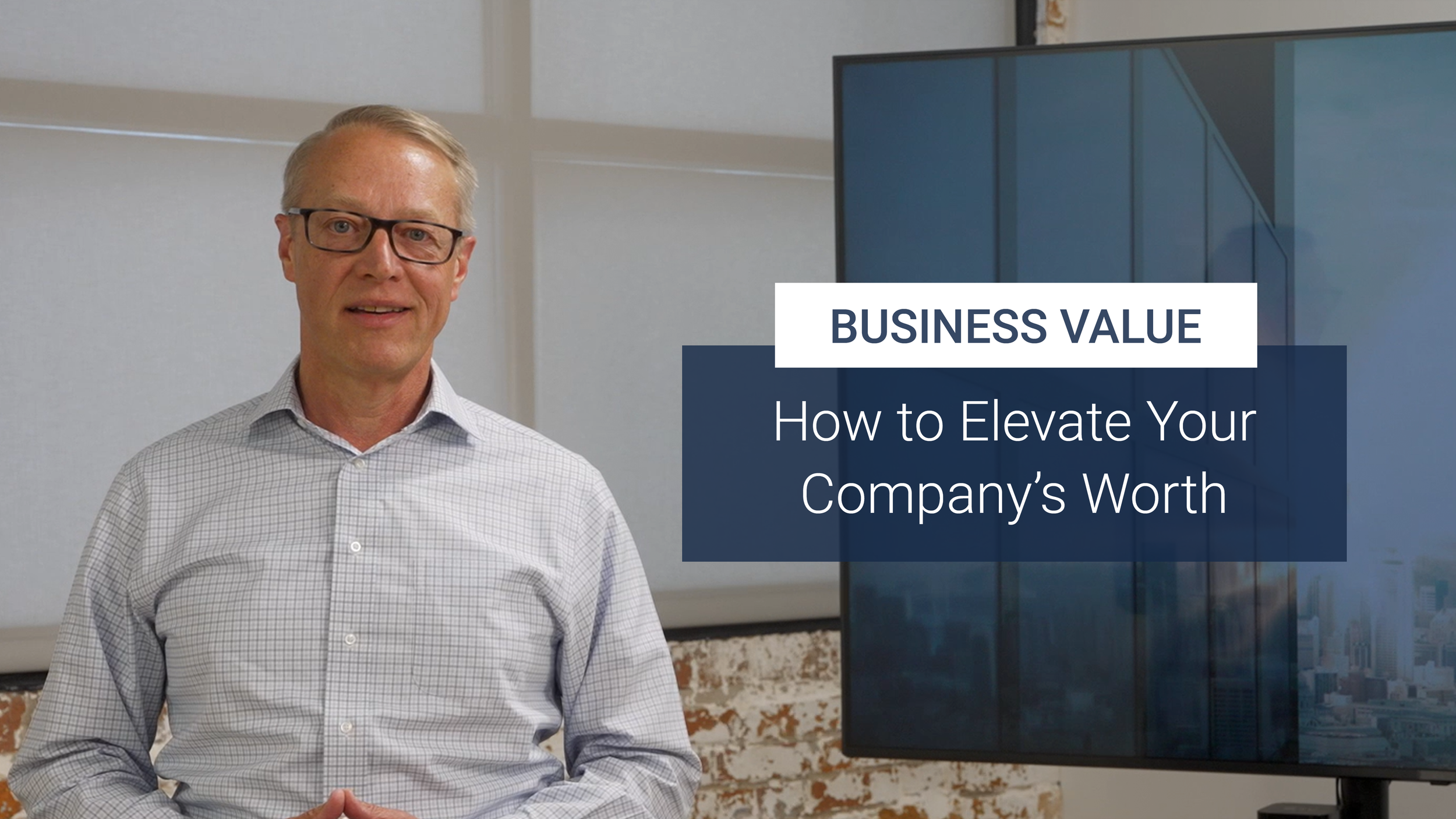
Who wouldn’t want a more valuable business? Whether you plan to continue owning and running the business or you want to transfer ownership, a more valuable business is a better one to own (and work in)!
The Importance of Intangible Factors
This is a key principle about unlocking the value of your business. As we all know, cash (flow) is king! But intangible factors are super important as well.
Let me illustrate that point with a hypothetical example. Consider two companies with the exact same annual cash flow but very different intangible factors.
Company A
Owner leads everything and makes all decisions
Basic internal financial reports
One customer = 50% of sales
Growing at 2% per year
High employee turnover
Weak processes & business systems
Company B
Has a capable, empowered leadership team
Accounting firm generates GAAP financials
No customer over 20% of sales
Growing at 7% per year
Low turnover; financial incentives in place
Efficient, scalable processes & systems
Which business would you rather own? Which would you rather buy? If you chose Company B, you are not alone.
In one of his famous annual shareholder letters, Warren Buffet once said, “It's far better to buy a wonderful company at a fair price than a fair company at a wonderful price.”
So how do you create a wonderful company, a business with unlocked value? Here are three steps.
1. Assess Your Business
Find where your opportunities are to unlock value. Consider all aspects of your business.
What is your financial strength (Balance Sheet, P&L, and Cash Flow) and how accurate are your financial statements?
What about your leadership team? Do you have a robust leadership team that’s helping you to drive the business? Or is the owner doing everything?
Are your processes and systems efficient and scalable?
How is your sales and marketing effort? Are you driving revenue growth?
Overall organization: What is the culture like? Do you have a deep talent pool? Do you have good employee incentives in place?
Looking at these areas will help you identify where your greatest opportunities are for unlocking the value of your business.
2. Plan and Prioritize Value-Acceleration Projects
Most companies can’t and shouldn’t tackle all of these opportunities at once. So consider:
Which value improvement projects will move the needle?
Which of these can you address, and where do you need help from trusted outside advisors?
The following tool is one way to help you prioritize your value acceleration opportunities.
It’s a “no brainer” to do something that has a high impact and doesn’t take much money or time. You probably want to pursue a few “quick wins” that even though they are low impact, they don’t cost much money or time. Obviously, you will not go for the projects in the “not worth it” quadrant that have a low impact and take lots of time and effort.
The challenge comes from those in the “good investment” quadrant because they have a high impact but they also take a lot of time and money. An example would be an ERP implementation. It would have high impact on transforming efficiency and customer service levels, but it costs a lot of money and takes a lot of time. So you can’t have too many projects in this quadrant.
Once you prioritize which projects to pursue, it’s time for Step 3: to execute the value acceleration.
3. Execute the Value Acceleration
Set quarterly SMART goals for projects you are implementing.
Create a regular cadence of accountability, at least monthly, to monitor progress on those goals.
Make sure the right people are involved in the project. This should be at least the leadership team and perhaps a few key other people.
Determine which outside help would allow you to make progress faster, help the team stay more accountable, and help you to sustain the gains.
Running a business is hard work. Unlocking the value of your business by increasing both cash flow and intangible factors makes it worth more and more worthwhile! We’d love to talk with you about how we can help you with this journey. Contact us to learn more.

Gray Wirth has served more than 30 years as a leader in corporate, nonprofit, small business, and military contexts. He has successfully led organizations ranging from 100 to 3,100 employees. Gray has lived and worked in five different countries, been a CEO, and accumulated more than 25 years of experience on nonprofit and for-profit boards. He brings experience in executive coaching, strategic planning, and advising boards of directors and business owners. As a Certified Exit Planning Advisor (CEPA®), Gray helps business owners plan in advance for future transitions to ensure that their business, personal, and financial objectives will be achieved. Gray is a U.S. Army veteran and holds a B.S. from Cornell University, an M.B.A. from Harvard University, and an M.A.R. from Westminster Theological Seminary.
![The Power of Encouragement [VIDEO]](https://images.squarespace-cdn.com/content/v1/571fc0ea1d07c0fd6d72c167/1789414441004-N7DEHJI02NM0YVIT8N7P/encouragement+blog.png)
![Effective Execution: 4 Steps to Follow Through on Your Strategy [VIDEO]](https://images.squarespace-cdn.com/content/v1/571fc0ea1d07c0fd6d72c167/1781035467211-90HEYTKBR01ZC8FUW8ZM/executive+blog.png)
![Unlocking Business Value: How to Elevate Your Company’s Worth [VIDEO]](https://images.squarespace-cdn.com/content/v1/571fc0ea1d07c0fd6d72c167/1778005993844-SA0MZVFB9I081V7ZRFQT/worth+blog.png)
![Leadership: Effective Leaders Drive Stick [VIDEO]](https://images.squarespace-cdn.com/content/v1/571fc0ea1d07c0fd6d72c167/1775573759312-L2X9PK1JUYIFFY2M67YX/drive+stick+blog.png)
![Developing a Successful Sales and Marketing Strategy [VIDEO]](https://images.squarespace-cdn.com/content/v1/571fc0ea1d07c0fd6d72c167/1770391559147-9Z6Q4BC1EY0R8BUHCATM/sales+blog.png)
![Gratitude: A Silver Bullet for Strengthening Morale [VIDEO]](https://images.squarespace-cdn.com/content/v1/571fc0ea1d07c0fd6d72c167/1768246672364-PQNI8VHO5EEPZ3IRMY7F/gratitude+blog.png)
![Public Speaking: Using AI Ethically & Effectively to Create a Powerful Speech [VIDEO]](https://images.squarespace-cdn.com/content/v1/571fc0ea1d07c0fd6d72c167/1763735597032-XMIKMQ1D63PRC1QJ6FVV/ai+speech+blog.png)
![Preparing for the (Expectedly) Unexpected [VIDEO]](https://images.squarespace-cdn.com/content/v1/571fc0ea1d07c0fd6d72c167/e4193bcf-29f7-46c2-be12-9116791d40cf/unexpected+blog.png)
![Fundraising: How to Raise Funds for Your Nonprofit [VIDEO]](https://images.squarespace-cdn.com/content/v1/571fc0ea1d07c0fd6d72c167/1757619882819-6OARWR0QU11M7LA0ABYL/fundraising+blog.png)
![Culture: 5 Traits That Set Healthy Churches & Their Leaders Apart [VIDEO]](https://images.squarespace-cdn.com/content/v1/571fc0ea1d07c0fd6d72c167/1755633039402-KVJFNJWG0RKBCMLS5FNB/healthy+blog.png)
![Vision: 3 Must-Have Traits of Every Successful Visionary Leader [VIDEO]](https://images.squarespace-cdn.com/content/v1/571fc0ea1d07c0fd6d72c167/1749484247758-ITEGD2LZZ716112KLHXZ/visionary+blog.png)
![Advisory Boards: Should Your Business Have an Advisory Board? [VIDEO]](https://images.squarespace-cdn.com/content/v1/571fc0ea1d07c0fd6d72c167/1747149791510-HU20SY0O8LRPEHGMC6HD/advisory+blog.png)
![Leadership: How to Be a World Class Boss [VIDEO]](https://images.squarespace-cdn.com/content/v1/571fc0ea1d07c0fd6d72c167/1744640489138-X5LUNZT3JTRQYSSZXV1C/boss+thumbnail.png)
![Conflict: The Importance of Having Tough Conversations [VIDEO]](https://images.squarespace-cdn.com/content/v1/571fc0ea1d07c0fd6d72c167/1741365599296-KTWEJ5PTNH1BX2GJ9REJ/Conversations+blog.png)
![Exit Planning: The Challenge of Business Exit Planning & Why It Matters to You [VIDEO]](https://images.squarespace-cdn.com/content/v1/571fc0ea1d07c0fd6d72c167/1738339040891-VIW87N2NCZUCKLYNOHB6/exit+blog.png)

![Teams: Is Your Team Dysfunctional? [VIDEO]](https://images.squarespace-cdn.com/content/v1/571fc0ea1d07c0fd6d72c167/1733243870005-NOI69Z74DLNVLIB8MRRJ/dysfunctional+blog.png)
![How to Recruit and Inspire Volunteers [VIDEO]](https://images.squarespace-cdn.com/content/v1/571fc0ea1d07c0fd6d72c167/1728421227208-6JAUFVXEJW5KK6YE58JR/volunteers+blog.png)
![Trust: 4 Steps to Rebuild Damaged Trust [VIDEO]](https://images.squarespace-cdn.com/content/v1/571fc0ea1d07c0fd6d72c167/1725969594417-7AN9PJO2X8TTR77ACDFP/trust+blog.png)
![Blind Spots: How to Identify & Avoid Blind Spots in Your Organization [VIDEO]](https://images.squarespace-cdn.com/content/v1/571fc0ea1d07c0fd6d72c167/1722610352594-FAXECLPC61QYJH2I5YT8/blind+spot+blog.png)
![Family Business: Will the Family Business Destroy Our Family? [VIDEO]](https://images.squarespace-cdn.com/content/v1/571fc0ea1d07c0fd6d72c167/1718027719043-MU9AYPTQ7GM4XWT9EGD1/destroy+blog.png)
![Teams: How to Breathe New Life into a Broken Team [VIDEO]](https://images.squarespace-cdn.com/content/v1/571fc0ea1d07c0fd6d72c167/1714749389916-G2CWVK8OM1JJSD9058CL/breathe+blog.png)
![Planning: The Power of Planning [VIDEO]](https://images.squarespace-cdn.com/content/v1/571fc0ea1d07c0fd6d72c167/1712597764732-WHRZPRLZ6V78CBGKBPZA/PLanning+blog.png)
![Leveling Up Your Leadership: Becoming an Effective Senior Leader [VIDEO]](https://images.squarespace-cdn.com/content/v1/571fc0ea1d07c0fd6d72c167/1710266273593-QN3HEBJ5FII4GKQFH91Q/leveling+up+blog.png)
![Recruiting & Retaining “Mature” Team Members [VIDEO]](https://images.squarespace-cdn.com/content/v1/571fc0ea1d07c0fd6d72c167/1707849950823-Y5WJLYXM6ZPU55TKG27Y/recruitment+blog.png)

![Gaslighting: How to Identify It & Take Back Control [VIDEO]](https://images.squarespace-cdn.com/content/v1/571fc0ea1d07c0fd6d72c167/1699381799669-Y6XNYG2X3ZD1US80XAFY/Gaslighting+blog.png)
![Decision-Making: Why Smart Leaders Do Dumb Things [VIDEO]](https://images.squarespace-cdn.com/content/v1/571fc0ea1d07c0fd6d72c167/1696947285846-ZIA5M26B5AF9SRFGWFPV/Dumb+Things+blog.png)
We are hearing it from organizations of every size: leaders are struggling to step up under pressure. Here are five ways to build courage and resilience into your leadership and your team.