
![Civil Discourse Cognitive Skills to Help You Understand Different Perspectives [VIDEO]](https://images.squarespace-cdn.com/content/571fc0ea1d07c0fd6d72c167/1673898642478-RKKE5JM6YMMKG460MCOD/Civil+Discourse+Cognitive+Skills+blog.png?content-type=image%2Fpng)
There is no doubt that our country is divided. As individuals have been affected, so have organizational cultures. Difference of opinion should not ruin relationships, but it does. Many of us are not equipped to have difficult conversations or to disagree with one another.
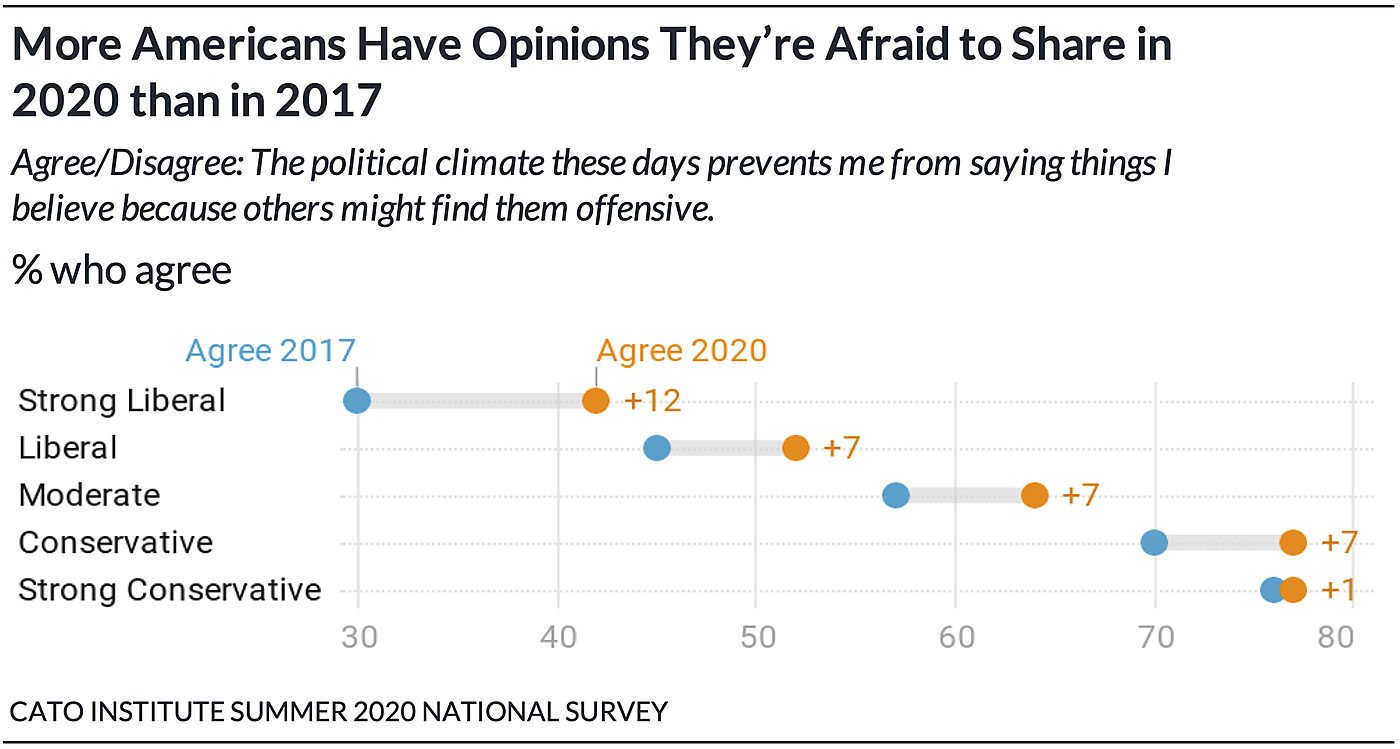
According to a 2020 national survey, 62% of Americans say they have political views they’re afraid to share. Self-censorship is on the rise in the US. In fact, the graphic below from the CATO Institute shows more Americans have opinions they're afraid to share in 2020 than in 2017 because they fear that others may find their beliefs offensive.
In civil discourse, there are six skills: three emotional and three cognitive. Today we are going to look at the three cognitive skills.
1. Cultivating Curiosity
Cultivating curiosity allows us to learn about others without judgment. It’s about asking questions, giving people the freedom to share, and just seeking to learn.
2. Taking Perspective
Distinct from empathy, taking perspective is about being able to articulate an idea different from your own. Understanding and being able to comprehend an idea doesn’t mean that you have to agree with it.
3. Engaging Effectively
Engaging effectively is about listening in a way that is fair, allowing a conversation to continue, and not shutting it down. It includes metacommunication which is all of our non-verbal cues: tone of voice, facial expressions, gestures, and body language. All of these play a part in whether or not an intended message was understood and received the way it was supposed to.
These three cognitive skills are less about feeling and more about understanding and comprehension. Be sure to check out our other video on the emotional skills of civil discourse.
I’ve personally seen these six civil discourse skills transform organizations, allowing them to communicate across differences and engage more effectively in diverse relationships.
Contact us to learn more about how our experienced consultants can facilitate in-depth training for your team on the topic of civil discourse.

Eryka Jenkins, M.Ed., brings experience in the areas of education, diversity and inclusion training, building culture, conflict management, and team building. Her previous experiences include working in education where she built community among students and partnered with faculty and division leadership to build cultural competency. A former Division 1 athlete, Eryka is also a certified strength and conditioning specialist, has crafted and led strength programs for various sports teams, and has served as a sports coach for over 10 years. She has an M.Ed. in Educational Leadership from Lehigh University, a Bachelor’s Degree in Hospitality Resort Management and Business from the University of Memphis, and a diversity and inclusion certificate from Cornell University.
![The Power of Encouragement [VIDEO]](https://images.squarespace-cdn.com/content/v1/571fc0ea1d07c0fd6d72c167/1789414441004-N7DEHJI02NM0YVIT8N7P/encouragement+blog.png)
Withhold encouragement from your team, and you will lose creativity, initiative, and commitment. Give it generously, and you will multiply their performance. Here’s how.
Some of the best leadership lessons I ever picked up during my time as a principal came from eighth graders. Here are three of those lessons that are also important for organizations of all types.
![Effective Execution: 4 Steps to Follow Through on Your Strategy [VIDEO]](https://images.squarespace-cdn.com/content/v1/571fc0ea1d07c0fd6d72c167/1781035467211-90HEYTKBR01ZC8FUW8ZM/executive+blog.png)
What separates thriving organizations from struggling ones? It almost always comes down to the follow-through. Here's why most organizations fail to execute well, and 4 steps to make your plan actually happen.
![Unlocking Business Value: How to Elevate Your Company’s Worth [VIDEO]](https://images.squarespace-cdn.com/content/v1/571fc0ea1d07c0fd6d72c167/1778005993844-SA0MZVFB9I081V7ZRFQT/worth+blog.png)
A profitable business isn’t always a valuable one. There are hidden factors quietly dragging down your company’s worth. Here are three steps to unlock the value of your business.
![Leadership: Effective Leaders Drive Stick [VIDEO]](https://images.squarespace-cdn.com/content/v1/571fc0ea1d07c0fd6d72c167/1775573759312-L2X9PK1JUYIFFY2M67YX/drive+stick+blog.png)
Many leaders are driving automatic - just reacting, performing, and surviving. But there is another way to lead, and it changes everything.
![Developing a Successful Sales and Marketing Strategy [VIDEO]](https://images.squarespace-cdn.com/content/v1/571fc0ea1d07c0fd6d72c167/1770391559147-9Z6Q4BC1EY0R8BUHCATM/sales+blog.png)
When sales and marketing chase different goals, failure and finger-pointing often follow. Here’s how to align them with an effective sales and marketing strategy.
![Gratitude: A Silver Bullet for Strengthening Morale [VIDEO]](https://images.squarespace-cdn.com/content/v1/571fc0ea1d07c0fd6d72c167/1768246672364-PQNI8VHO5EEPZ3IRMY7F/gratitude+blog.png)
U.S. businesses lose nearly a trillion dollars a year to employee turnover. And while the causes are complex, one simple behavior can make a difference: gratitude. Here’s how to build it into your life.
![Public Speaking: Using AI Ethically & Effectively to Create a Powerful Speech [VIDEO]](https://images.squarespace-cdn.com/content/v1/571fc0ea1d07c0fd6d72c167/1763735597032-XMIKMQ1D63PRC1QJ6FVV/ai+speech+blog.png)
Yes, AI can make writing a speech easier, but only you can make it meaningful. Here’s how to ethically use AI to strengthen your message without losing your voice.
![Preparing for the (Expectedly) Unexpected [VIDEO]](https://images.squarespace-cdn.com/content/v1/571fc0ea1d07c0fd6d72c167/e4193bcf-29f7-46c2-be12-9116791d40cf/unexpected+blog.png)
Even the strongest organizations can crumble under financial strain, leadership turnover, or sudden disruptions. Here’s how you can prepare for the unexpected before it’s too late.
![Fundraising: How to Raise Funds for Your Nonprofit [VIDEO]](https://images.squarespace-cdn.com/content/v1/571fc0ea1d07c0fd6d72c167/1757619882819-6OARWR0QU11M7LA0ABYL/fundraising+blog.png)
Fundraising is challenging, but with the right approach, you can engage people in your mission and build lifelong donor relationships. Here’s how.
![Culture: 5 Traits That Set Healthy Churches & Their Leaders Apart [VIDEO]](https://images.squarespace-cdn.com/content/v1/571fc0ea1d07c0fd6d72c167/1755633039402-KVJFNJWG0RKBCMLS5FNB/healthy+blog.png)
A lot of churches struggle with momentum, leadership, and morale. Here are 5 traits that consistently set the healthiest churches and their leaders apart, and how you can build them into your own ministry.
![Vision: 3 Must-Have Traits of Every Successful Visionary Leader [VIDEO]](https://images.squarespace-cdn.com/content/v1/571fc0ea1d07c0fd6d72c167/1749484247758-ITEGD2LZZ716112KLHXZ/visionary+blog.png)
If your organization is stuck, the issue might be a lack of vision. Here are 3 traits found in leaders who can move things forward.
![Advisory Boards: Should Your Business Have an Advisory Board? [VIDEO]](https://images.squarespace-cdn.com/content/v1/571fc0ea1d07c0fd6d72c167/1747149791510-HU20SY0O8LRPEHGMC6HD/advisory+blog.png)
You don’t have to lead alone. The smartest business owners surround themselves with wisdom. Here’s how an advisory board can benefit your company.
![Leadership: How to Be a World Class Boss [VIDEO]](https://images.squarespace-cdn.com/content/v1/571fc0ea1d07c0fd6d72c167/1744640489138-X5LUNZT3JTRQYSSZXV1C/boss+thumbnail.png)
Want to be the kind of leader people talk about at dinner in a good way? Here’s how to become a world-class boss in 7 steps.
![Conflict: The Importance of Having Tough Conversations [VIDEO]](https://images.squarespace-cdn.com/content/v1/571fc0ea1d07c0fd6d72c167/1741365599296-KTWEJ5PTNH1BX2GJ9REJ/Conversations+blog.png)
Every difficult conversation is an opportunity for growth. Here’s how to embrace them and transform your culture for the better.
![Exit Planning: The Challenge of Business Exit Planning & Why It Matters to You [VIDEO]](https://images.squarespace-cdn.com/content/v1/571fc0ea1d07c0fd6d72c167/1738339040891-VIW87N2NCZUCKLYNOHB6/exit+blog.png)
Most business owners delay exit planning until it’s too late. Here are the three essential pillars of a successful transition so you can plan to step away on your own terms and not leave it up to chance.

From finding your motivation to taking ownership of your mistakes, here are six lessons from athletics that will help you lead more effectively in the workplace.
![Teams: Is Your Team Dysfunctional? [VIDEO]](https://images.squarespace-cdn.com/content/v1/571fc0ea1d07c0fd6d72c167/1733243870005-NOI69Z74DLNVLIB8MRRJ/dysfunctional+blog.png)
Is your team dysfunctional? Here are six symptoms to help you identify if it is dysfunctional and if it is time to get help.
![How to Recruit and Inspire Volunteers [VIDEO]](https://images.squarespace-cdn.com/content/v1/571fc0ea1d07c0fd6d72c167/1728421227208-6JAUFVXEJW5KK6YE58JR/volunteers+blog.png)
Recruiting volunteers is incredibly difficult, especially since only about 1 in 4 U.S. adults volunteer each year. Here are five strategies leaders can use to recruit and inspire their volunteers.
![Trust: 4 Steps to Rebuild Damaged Trust [VIDEO]](https://images.squarespace-cdn.com/content/v1/571fc0ea1d07c0fd6d72c167/1725969594417-7AN9PJO2X8TTR77ACDFP/trust+blog.png)
Rebuilding damaged trust is not impossible, but it does require diligence. Here are four steps to rebuild damaged trust.
![Blind Spots: How to Identify & Avoid Blind Spots in Your Organization [VIDEO]](https://images.squarespace-cdn.com/content/v1/571fc0ea1d07c0fd6d72c167/1722610352594-FAXECLPC61QYJH2I5YT8/blind+spot+blog.png)
All organizations have blind spots, and when they go unchecked, they can cause a catastrophic event. Here’s how to identify and avoid blind spots in your organization.
![Family Business: Will the Family Business Destroy Our Family? [VIDEO]](https://images.squarespace-cdn.com/content/v1/571fc0ea1d07c0fd6d72c167/1718027719043-MU9AYPTQ7GM4XWT9EGD1/destroy+blog.png)
Will your family business destroy your family? Here are the opportunities and landmines found in family businesses, and how you can avoid those landmines in yours.
![Teams: How to Breathe New Life into a Broken Team [VIDEO]](https://images.squarespace-cdn.com/content/v1/571fc0ea1d07c0fd6d72c167/1714749389916-G2CWVK8OM1JJSD9058CL/breathe+blog.png)
Teams are inherently dysfunctional. But as the leader, you have the power to change that. Here are 9 steps to bring new life into your team.
![Planning: The Power of Planning [VIDEO]](https://images.squarespace-cdn.com/content/v1/571fc0ea1d07c0fd6d72c167/1712597764732-WHRZPRLZ6V78CBGKBPZA/PLanning+blog.png)
Planning allows you to take a chaotic state, narrow it down, and turn it into momentum and energy toward your goal. Here is how.
![Leveling Up Your Leadership: Becoming an Effective Senior Leader [VIDEO]](https://images.squarespace-cdn.com/content/v1/571fc0ea1d07c0fd6d72c167/1710266273593-QN3HEBJ5FII4GKQFH91Q/leveling+up+blog.png)
As you move up through the levels of leadership, the way you lead needs to change as well. As it has been said, “What got you here, won’t get you there!” Here are three areas where you need to lead differently to be an effective senior leader.
![Recruiting & Retaining “Mature” Team Members [VIDEO]](https://images.squarespace-cdn.com/content/v1/571fc0ea1d07c0fd6d72c167/1707849950823-Y5WJLYXM6ZPU55TKG27Y/recruitment+blog.png)
In the movie “The Intern,” Robert De Niro is a retired executive who rejoins the workforce as a senior intern. This may sound like a story made just for the movies, but it matches our reality today. With the population aging and not enough young people to fill the available positions in the workforce, leaders are going to have to be creative to fill in the gaps. Here’s how.

There was a time in my life when my leadership hit a wall, and I realized that I needed a leadership coach. My career is now at a point where I am healthy and whole and that is because of the coach who helped me through my journey. Here are three ways a coach can help you.
![Gaslighting: How to Identify It & Take Back Control [VIDEO]](https://images.squarespace-cdn.com/content/v1/571fc0ea1d07c0fd6d72c167/1699381799669-Y6XNYG2X3ZD1US80XAFY/Gaslighting+blog.png)
Gaslighting may seem like a newer term, but it originated in a 1944 movie where a man deliberately convinced his wife that she was insane so that he could steal her family’s treasure. Here are the different ways people gaslight others and five steps to help you take back control if it is happening to you.
![Decision-Making: Why Smart Leaders Do Dumb Things [VIDEO]](https://images.squarespace-cdn.com/content/v1/571fc0ea1d07c0fd6d72c167/1696947285846-ZIA5M26B5AF9SRFGWFPV/Dumb+Things+blog.png)
There are a lot of examples of people who are perhaps smart, but not smart all the time. Here are five reasons smart leaders sometimes do dumb things.
We are hearing it from organizations of every size: leaders are struggling to step up under pressure. Here are five ways to build courage and resilience into your leadership and your team.